History of the Indiana Workers' Movement: The 1919 Steel Strike
Summer Miller
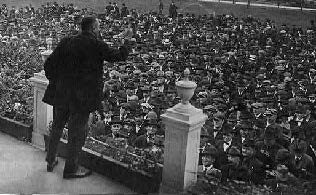
The 1919 steel strike was a national confrontation between the working class and one of the central industries of American capitalism, stretching across the Steel Belt and drawing in workers in 50 cities across 10 states.
More than 350,000 steelworkers struck nationwide in September 1919 after years of brutal exploitation: 12-hour shifts, dangerous conditions, harsh discipline, and low wages eaten away by postwar inflation.
The political center of the struggle was Gary, Indiana, a stronghold of U.S. Steel power.
Steelworkers were moving into battle against one of the biggest and most ruthless industries in American capitalism. U.S. Steel was the world’s first, and at the time only, billion-dollar company. But there was a contradiction at the heart of the strike: the enormous power of the workers, and the political weakness of the union leadership in the American Federation of Labor (AFL).
The capitalists understood that even a partial victory for the workers could encourage much wider struggle.
The bosses answered the strike with organized repression, backed up by every institution of capitalism. The steel companies used court injunctions, police terror, company gunmen, mass arrests, and nonstop press propaganda to wear workers down and isolate the strike. Injunctions and court orders were used to ban or severely restrict mass picketing, public rallies, parades, and even union meetings in key steel towns. That meant strikers could not easily gather, show their numbers, reach workers still inside the mills, or maintain visible organization in the streets.In Gary, the state went even further. Martial law was declared, public meetings were banned, soldiers patrolled the streets, and workers were treated like an occupied population
The bosses also relied heavily on divide-and-rule, especially racism. They brought in Black workers as scabs and used them as a weapon against the strike. The employers also kept immigrant workers divided and segregated on the job, making it easier to keep the whole workforce fragmented and suspicious of each other.
The AFL leadership approached this confrontation with a strategy completely out of step with the scale of the struggle.
Instead of waging a real fight to unite Black, white, and immigrant workers in common struggle against the steel trusts, union leaders continued the racist and conservative policies of “craft unionism.”. .
For decades, unions had excluded Black workers from membership, which played into the bosses’ hands. The union leadership also divided workers up by trade. This forced steelworkers to coordinate their strike across 24 separate unions, when the bosses were organized through centralized corporate power. Militant workers argued for unity between Black and white workers, and for all steelworkers to unite in a single industrial union.
Under AFL President Samuel Gompers, the union relied on class collaboration and operated through channels acceptable to the Democratic and Republican parties. Instead of preparing workers for an independent class confrontation, it was committed to respectability, compromise, and keeping the struggle within limits the capitalist establishment could tolerate. In a struggle of this magnitude, the conservative approach of the AFL became a deathly liability to the strike and left workers more exposed to repression, division, and isolation.
The unity needed to defeat the bosses had to be fought for consciously and politically. A revolutionary leadership would have made the fight against racism and national division central to building one industrial union and one common struggle against the bosses.
The capitalist New York Times saw the danger that socialist leadership and working-class unity posed to the bosses. Two days after the strike began, they wrote: “It is industrial war in which the leaders are radicals, social and industrial revolutionaries, while their followers are chiefly the foreign element among the steel workers, steeped in the doctrines of the class struggle and social overthrow, ignorant and easily misled.” They urged the conservative union leadership to get control: “The authority and the leadership of Mr. Gompers are at stake in this strike.”
Despite the courage and scale of the struggle, the 1919 steel strike ended in defeat. It was officially called off on January 8, 1920, with no concessions won from U.S. Steel. But the defeat still left a mark on the whole class struggle. 350,000 workers had struck for four months, slashing production and scaring the hell out of the steel bosses. It stood as a warning of how explosive a national steel confrontation could become and hung over every major steel battle that followed.
When the next great wave of industrial struggle came in the 1930s, the steel bosses still remembered the strike of 1919. They watched as workers shut down the auto industry in a mass wave of “sit-down strikes.” They didn’t want the strike to spread to steel, and they didn’t want a repeat of 1919. In 1937, U.S. Steel recognized the Steel Workers Organizing Committee without a national strike.
The deeper lesson is that the defeats of 1919 were not the end of the story. They were part of the hard historical experience through which the working class learned, reorganized, and returned to struggle on a higher level.
The great postwar steel strike of 1946 won a major wage increase, and the battles that followed helped secure pensions and social insurance, helping make steel one of the best-paid unionized industries in the country. The 1919 strike was defeated, but it was also a warning to the ruling class and a sign of what workers’ power could become when it moved into struggle on a mass scale.