The FDR They Don’t Tell You About
Gwendolyn Hart
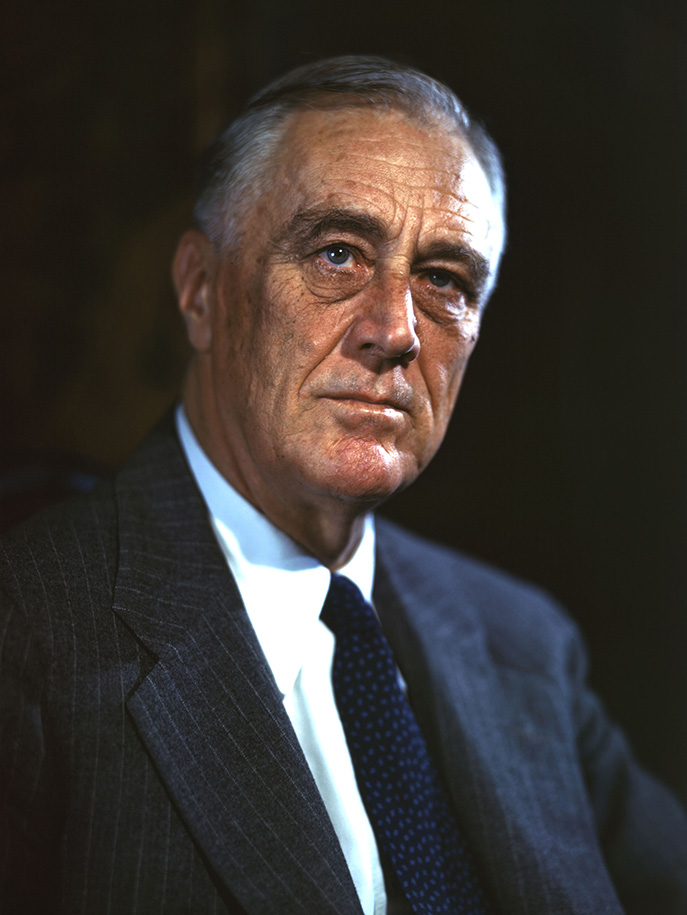
The Democratic Party lives large on the mythology of Franklin D. Roosevelt. Bernie Sanders cited the New Deal to claim the party can supposedly be reformed to serve the workers. When Joe Biden was inaugurated, Democrats hailed him as “the most pro-union president since FDR” — and kept up shouting this lie even as Biden wielded the power of the federal government to break the railroad workers’ strike.
But the myth is just that: a revisionist history the Democratic Party has constructed to hold on to support from working-class voters.
FDR ran for president in 1932 in the midst of the Great Depression and was swept into power by mass anger at the Hoover administration. Herbert Hoover was dogmatically opposed to state intervention, and claimed the crisis was merely a matter of restoring “investor confidence.” Millions upon millions of workers were cast into immiseration every year under Hoover, often ending up in the homeless encampments and shantytowns springing up everywhere that they titled “Hoovervilles”.
To Roosevelt, state intervention was a necessary evil to solve the crisis, but he wanted it to end there. He was opposed to real reform. In fact, he ran his 1932 election promising budget cuts. The first New Deal was designed not to give the unemployed masses real relief, but to get them back on the job. The Unemployed League called it “not enough to live on and just too much to die on” — even then it didn’t cover 75% of the unemployed. Most of the New Deal programs didn’t last two years, and in his 1935 state of the union address FDR declared, “The federal government must and shall quit this business of relief.”
But the Great Depression had put the bankruptcy of the capitalist system on full display. The working class was not content to wait patiently for the capitalists to drop enough scraps to save their lives and were becoming increasingly organized.
In 1934, there were three powerful strikes led by socialists in Minneapolis, San Francisco, and Toledo. This sparked a massive strike wave across the country that doubled union membership in just a few years. And there was a very real possibility of a new working-class party forming that could threaten the capitalist system. The Socialist and Communist Parties grew by the tens of thousands, and the Minnesota Farmer-Labor Party dominated that state’s politics.
Roosevelt recognized the workers’ movement was too powerful to crush, so it had to be co-opted and defanged. For his re-election, he shifted his rhetoric sharply to the left. Gone was the talk of cutting taxes on business and “balancing the budget” from his 1932 election, and in its place was talk of taxing the rich and praise for the trade unions.
The immense pressure of the movement forced FDR to make concessions to win support, leading to the more-famous second New Deal which included social security, the minimum wage, and the 40-hour week. But always Roosevelt maneuvered for the smallest concessions possible. Even as he praised the unions verbally, he refused to support the Labor Relations Bill which created the NLRB, until it became clear it would pass with or without him.
All this was done with the goal of absorbing even the most radical leadership from the unions and the movement into the Democratic Party, where they could be safely controlled. John Lewis, president of the Congress of Industrial Organizations, described the tactic he saw over and over again:
“In a quiet, confidential way he [Roosevelt] approaches one of my lieutenants, weans his loyalty away, overpowers him with the dazzling glory of the White House, and appoints him to a federal post under such circumstances that his prime loyalty shall be to the President and only a secondary, residual one to the working-class movement from which he came.”
In 1938, the reforms dried up because Roosevelt had succeeded. The leaders of the movement had largely been co-opted to stake their future careers on FDR’s success, and those that remained cravenly retreated from the task of forming a new party. Formations like Farmer-Labor were then crushed even at the expense of losing their seats to Republicans, and their remnants were absorbed into the Democratic Party.
After 1940, the mask came off. FDR began smearing militant workers as anti-American and using the FBI as an intimidation tool. In 1941, he became an open strikebreaker. On June 7, aircraft manufacturing workers launched a strike at North American Aviation in Inglewood, CA demanding a ten cent raise. Rather than force the company to make a deal, Roosevelt sent in federal troops to break the strike. Once the U.S. entered World War II in December of that year, the strikebreaking only escalated.
If these tactics sound familiar, that’s because this is still the Democrats’ playbook today. Bernie and Mamdani echo FDR’s false promises of reforming the party into a progressive one, just to watch them break strikes and crush unions. The difference is that our present co-opted misleaders are selling us all out for a much, much lower price.
The failure to launch a new party has resulted in nearly a century of dead-end collaboration with the Democratic Party. We need a new workers’ party with revolutionary leadership. Only that threat can win serious concessions like the New Deal and ultimately overthrow the capitalist system.