History of the Seattle Workers' Movement: Black Panthers’ Free Health Clinics
Summer Miller
On 21st & Yesler, the Carolyn Downs Family Medical Center stands as a legacy of the Black Panthers’ fight for free healthcare in Seattle.
In 1968, Seattle became the Black Panther Party’s second chapter, with 19-year-old Aaron Dixon as captain. From a storefront in Madrona, the chapter expanded into a larger space at Madrona Community Presbyterian Church, where Elmer Dixon helped build the Panthers’ free breakfast program until it grew to five sites. The chapter also organized free transportation for families visiting relatives in prison.
The Panthers began setting up Peoples’ Free Medical Clinics in 1968, including in Kansas City, Chicago, and Seattle. Black people were still being denied decent medical care even after racial exclusion had supposedly been outlawed under the 1965 Medicare and Medicaid Act. In practice, Black patients were pushed into neglected public hospitals and underfunded clinics.
In Seattle, party member Leon “Valentine” Hobbs III worked with volunteer medical staff to open a clinic in the Panthers’ new Central Area headquarters on 20th Avenue. It opened on December 1, 1969, as the Sidney Miller Free Clinic, named for Sidney Miller, a party member who was shot and killed while attempting to rob a 7-11 Speedee-Mart in West Seattle on December 2, 1968.
The clinics offered first aid, vaccinations, and screenings for high blood pressure, lead poisoning, tuberculosis, and diabetes. Chapters raised money locally. Volunteer medical workers staffed the clinics alongside community members trained as lab technicians, patient advocates, and health workers. By 1970, the party required every chapter to open a clinic, and ten more opened that year.
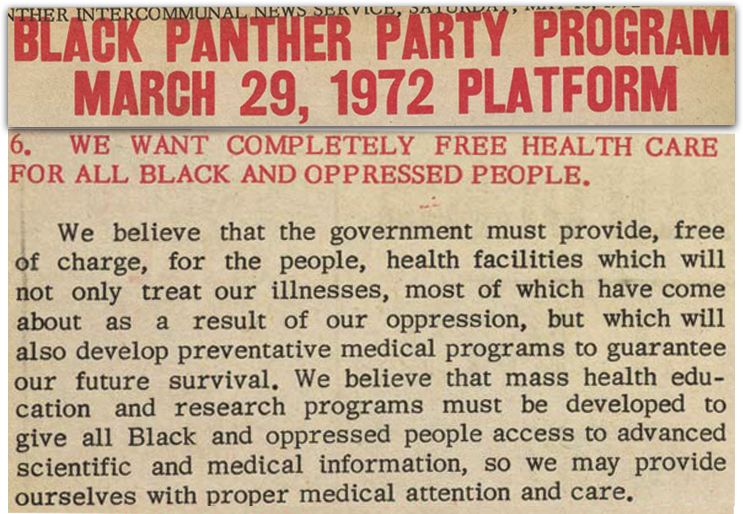
Health was not part of the Panthers’ original 1966 Ten-Point Program. But as the party developed, its increasingly Marxist politics and its clinic work pushed free healthcare into the program. In 1972, healthcare was written into the revised Ten-Point Program, which also broadened their demands to include not just Black people, but all “Black and oppressed people.”
The power of the Panthers was not in mutual aid — it was in their revolutionary program and organization, and the threat they posed to capitalism and its political parties. In 1970, Huey Newton explained the transformation of the Panthers into a revolutionary socialist organization:
“In 1966 we called our Party a Black Nationalist Party. We called ourselves Black Nationalists because we thought that nationhood was the answer. Shortly after that we decided that what was really needed was revolutionary nationalism, that is, nationalism plus socialism. After analyzing conditions a little more, we found that it was impractical and even contradictory. Therefore, we went to a higher level of consciousness. We saw that in order to be free we had to crush the ruling circle and therefore we had to unite with the peoples of the world.”
The revolutionary threat of the Black Panthers scared the U.S. ruling class, and forced them to grant concessions, including a major victory against sickle cell anemia.
Sickle cell had been identified decades earlier, but the medical establishment neglected it and starved it of serious funding and research because it mainly affected Black people. Beginning in 1971, the Panthers used their clinics for widespread community education and mass screening. They exposed that neglect and made it impossible to ignore. Their campaign helped force Congress to pass the National Sickle Cell Anemia Control Act in 1972, creating national genetic counseling, testing, and research to diagnose and treat sickle cell anemia.
The fate of the Panthers’ free health clinics shows the limits of mutual aid under capitalism. The Sidney Miller Free Medical Clinic, like the Panthers’ other clinics, came under constant pressure. City health officials harassed it. Police carried out raids. It was often difficult to keep enough volunteer medical staff to run it consistently. Early on, the clinic was forced to operate out of a basement.
Over time, those pressures helped shut down all of the Peoples’ Free Medical Clinics except one. Elmer Dixon, co-founder of the Seattle chapter, helped win federal funding that allowed the clinic to survive as an independent health center. In 1978, it reopened as the Carolyn Downs Family Medical Center, named for a Panther organizer central to the work of the Seattle chapter.
Carolyn Downs is no longer a free clinic. It has been starved of public funds, forced to operate at a loss and scrap for grants from wealthy foundations. Now it operates on a sliding scale. But for less than 5 percent of the Seattle police budget, we could make Carolyn Downs free again.
As long as healthcare is run for profit, the capitalist class will ration care, neglect the poor, and force Black and working-class people to pay with sickness and early death. Winning free, high-quality healthcare for all means building a mass working-class fight to tax the rich, take the giant healthcare, pharmaceutical, and insurance corporations into democratic public ownership, and wrest control of healthcare out of capitalist hands.