
History of the Seattle Workers’ Movement: 1919 Seattle General Strike
Gwendolyn Hart
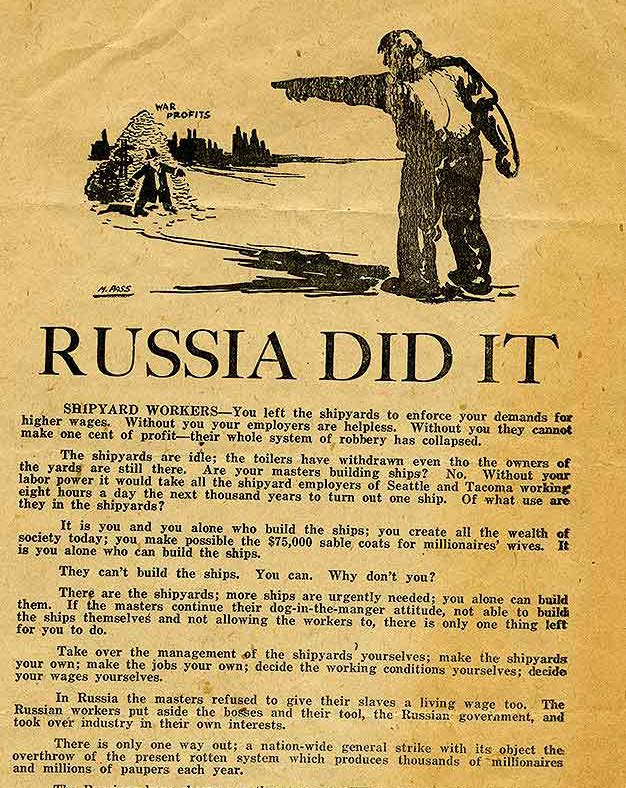
On February 6th, 1919 one hundred thousand workers in Seattle staged a general strike that shut down the city. Although they were defeated, they gave us a glimpse of the untapped power of the working class.
Origins of the General Strike
During World War I, the bosses used the excuse of war measures to force deplorable conditions onto the backs of the working class. Seattle dockworkers were instrumental in fulfilling the increased shipping demands, but were made to work under a strict wage freeze, which they were told would be lifted once the war ended.
There was never any intention of fulfilling this promise. After the war was over and the dockworkers demanded their pay, the bosses refused.
What the bosses didn’t count on was the rise in working-class militancy. For decades they had relied on the sellout union leadership of the American Federation of Labor (AFL), which had struck a craven bargain to help put down any and all strikes in exchange for the legal recognition of their union organizations.
But this was changed by the experience of WWI, after millions of workers were killed by the competing interests of British and German capitalism. Workers in the U.S. flooded into the unions to fight for their own interests. In Seattle, union membership quadrupled from 1915-1919: going from 15,000 to 60,000 union workers.
The port of Seattle put them in contact with sailors from Russia, where workers had taken state power for the first time in history. As one labor journalist at the time put it:
[P]amphlets were seen by hundreds on Seattle’s streetcars and ferries, read by men of the shipyards on their way to work. [...] Boilermakers, machinists, and other metal trades unions alluded to shipyards as enterprises which they might soon take over, and run better than their present owners ran them. These allusions gave life to union meetings.
Seattle’s Workers Take the Streets
The dockworkers went on strike, then appealed to the Seattle Labor Council to call a mass strike in solidarity. As luck would have it, all the regular union misleaders were out of town at a special AFL conference in Chicago. The general membership of the unions got to vote directly on whether to answer the call and responded with overwhelming solidarity.
110 unions and 100,000 workers joined the strike — one-third of Seattle’s total population. They elected a 330-member General Strike Committee to lead the city.
The committee took over directing all essential services. Cooks and waiters organized a department to provide regular meals to 30,000 striking union members. When the bosses tried cutting off the city’s access to milk in order to starve out the workers’ babies, drivers organized their own large-scale distribution system. Veterans organized a labor guard to keep the peace, a force that would not use weapons or police power but persuasion alone. Even opponents of the strike were forced to admit they had never seen a city so orderly.
In the end, the strike was defeated by an attack on two fronts. Soldiers were deployed from Fort Lewis under a general authorized to use martial law. At the same time the AFL and the national union officials, afraid the strike would threaten their relationship with the bosses, were exerting enormous pressure to shut down the strike. Unable to contend with these conditions, the strike committee voted to end the general strike after five days.
Legacy of the General Strike
The general strike was defeated for two reasons. They had no strategy to escalate the strike beyond the limits of Seattle and therefore could not stand up to military occupation, nor win over the soldiers. Even more important was the lack of a clear program of demands that could turn the strike into a broader political movement.
The Russian Revolution succeeded because it was organized through a revolutionary socialist party. Workers in Seattle didn’t have a party to turn their dreams of running the shipyards into a reality.
Still, the experience of the Seattle General Strike was essential. It connected the American workers with the wave of militant strike action sweeping the world after WWI.
Fifteen years later, the American working class would show what a general strike led by socialists with clear demands could accomplish. In 1934, general strikes in Minneapolis, San Francisco, and Toledo ignited a strike wave across the country. Militant workers broke with the AFL and contested it for leadership of the labor movement. They won concessions on the federal level, including the passage of the New Deal. This is the closest the U.S. ever came to establishing a workers’ party.
Today, labor is once again stifled by sellout union leaders. We need to reignite the militancy of the labor movement, break with the sellouts, and build a party of the working class.